
A 55-year-old male with PMHx HTN, HLD, Type III Achalasia underwent POEM (per oral endoscopic myotomy) one month ago and is now being seen in your clinic for scheduled follow up. At a one month follow up visit, which symptom profile is most expected?
- Complete resolution of dysphagia with no reflux symptoms
- Persistent severe dysphagia requiring repeat intervention
- Marked improvement in dysphagia with mild chest discomfort and reflux symptoms
- Progressive dysphagia and weight loss
Show Answer
The correct answer is C, marked improvement in dysphagia with mild chest discomfort and reflux symptoms.
POEM PEARLS
Procedure
- POEM stands for per oral endoscopic myotomy and it is an endoscopic, minimally invasive procedure developed for the treatment of achalasia.
- Procedure involves endoscopic mucosal incision, creation of submucosal tunnel with performance of myotomy of lower esophageal sphincter (LES), and closure with endoscopic clips, all without external incisions.
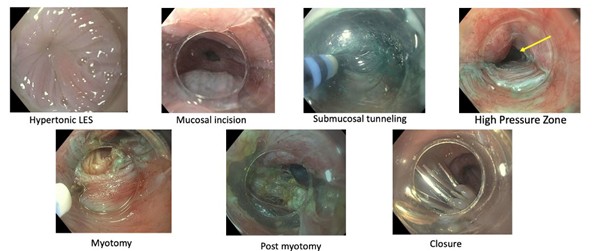
Images from personal library of Katelyn Cookson
- At most institutions, patients are admitted for overnight observation
Candidate Selection
- Diagnosis of achalasia with diagnostic work up including high resolution manometry, timed barium esophagram, upper endoscopy and thorough medication review
- Pre-procedure Eckardt score should be obtained
- Typically, best for type III achalasia
- Ok to proceed if patient has had prior Heller myotomy
- Less optimal candidates:
- Unable to hold chronic anticoagulation for periprocedural period
- Very high-risk anesthesia candidates
- Diagnosis of gastroparesis
- Patients who do not want to be on PPI long term (possibly lifelong)
Risks
- Short term, procedural related:
- Esophageal injury, pneumoperitoneum, subcutaneous emphysema, chest pain
- Most intraprocedural risks can be addressed at time of procedure
- Serious adverse event rate < 0.5%
- Mild chest pain with slowly improving dysphagia may be expected in the immediate weeks following procedure
- Long term
- GERD
- Reported in up to 58% of patients post procedure
- Less patients are symptomatic
- Patients may require lifelong PPI therapy
- Surveillance EGD 6-12 months after procedure should be considered regardless of patient symptoms
Outcome
- Clinical success as defined as Eckardt score 3 or less achieved in 87-91% at 4-5 years
- When compared to Heller myotomy POEM has:
- Similar efficacy
- Higher risk GERD
- Shorter operative time
- Shorter hospital stay
- Comparable overall complication rates
- Lower rates of serious AEs, need for surgery, need for reintervention
Clinical Follow-up Pearls
- Dysphagia to improve gradually over weeks, do not anticipate an immediate resolution
- Early chest discomfort and reflux symptoms are common and typically improve with time
- Reinforce PPI compliance
- Consider surveillance EGD even if patient is not symptomatic
REFERENCES
- AGA Clinical Practice Update on Advances in Per-Oral Endoscopic Myotomy (POEM) and Remaining Questions—What We Have Learned in the Past Decade: Expert Review. Yang, Dennis et al. Gastroenterology, Volume 167, Issue 7, 1483 – 1490
- Zhang H, Zeng X, Huang S, et al. Mid-Term and Long-Term Outcomes of Peroral Endoscopic Myotomy for the Treatment of Achalasia: A Systematic Review and Meta-Analysis. Dig Dis Sci. 2023;68(4):1386-1396. doi:10.1007/s10620-022-07720-4
- Ma O, Brar K, McCluskey S, Morris-Janzen D, Peabody J, Turner S. Long-term outcomes after per-oral endoscopic myotomy versus laparoscopic Heller myotomy in the treatment of achalasia: a systematic review and meta-analysis. Surg Endosc. 2025;39(9):5985-5994. doi:10.1007/s00464-025-11895-y
Author
Katelyn Cookson, PA-C is a Physician Assistant specializing in Gastroenterology at UCHealth Digestive Health Center and is also an Instructor at University of Colorado Anschutz Medical Campus. Katelyn serves as co-Chair the ASGE APP Committee.